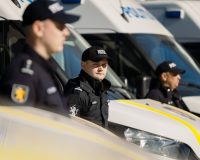
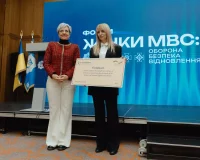
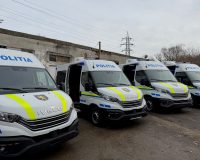
Two weeks ago today, a professional programme began in Berlin that addressed a key question: How can professional police communication succeed including under public pressure? Twelve police press officers from the Republic of Moldova came to the German capital for several days to discuss this issue. The programme included training, expert discussions and insights into German communication practices.
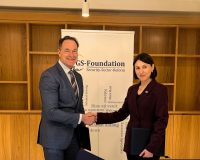
At the beginning of the trip, the importance of reliable collaboration became clear. Delegation leader Diana Fetco-Cupet said: ‘The Moldovan police have many international partners. The GS Foundation is one of the most reliable.”
Strategic communication as a starting point
The programme commenced with a one-day communication training course. The focus was on professional strategic communication in police contexts. It was less about formal language rules and more about the targeted use of linguistic tools in press and public relations work.
The participants dealt with issues of taking responsibility, communicating under pressure and dealing with sensitive topics. Theory and guided practice were closely linked. It became clear that effective police communication requires structure, clarity and the ability to reflect on and put into context one’s own actions.
Professional exchange with the Berlin Police
A central part of the programme was the exchange with representatives of the Berlin Police. Topics discussed included cross-media operational communication in large-scale situations, communication during operations, and the strategic use of social media and open-source intelligence (OSINT).
Concrete practical examples illustrated how traditional press relations, digital channels and operational communication intersect. The dialogue provided an opportunity for questions and comparisons with the participants’ own work practices and was perceived by the participants as particularly insightful.
Political context: the Reichstag glass dome
The professional programme was complemented by an audio-guided tour of the Reichstag dome of the German Bundestag. The tour provided insights into the architecture, history and functioning of the parliament building. The glass dome is considered a symbol of transparency and democratic processes.
The location placed the technical topics of the trip into a political context.
Media work from a journalistic perspective
The programme then continued at public broadcasting service Rundfunk Berlin-Brandenburg (rbb). There, the delegation gained insights into journalistic working methods, editorial processes and the role of public media in Germany. The tour of the television and radio studios provided a practical insight into production processes and editorial decisions.
The trip ended after a week. What remains are discussions, new contacts and comparison of different working methods. The exchange with the Berlin Police and rbb showed how strongly communication work is influenced by context and structure – and how much can be clarified through direct dialogue. International encounters such as these create the necessary space for this.