In April and May 2026, two specialist capacity-building workshops were held, bringing together representatives of Moldovan institutions working in the fields of civil protection and border management. The aim of the events was to strengthen project coordination, monitoring mechanisms and institutional preparedness in the context of European funding opportunities and the implementation of INTERREG projects. The activities organised for the General Inspectorate for Emergency Situations (GIES) and the General Inspectorate of Border Police (GIBP) focused on improving internal coordination, preventing irregularities and developing strategic approaches to project management and implementation.
Strategic Coordination for EU Funding Opportunities – GIES Workshop
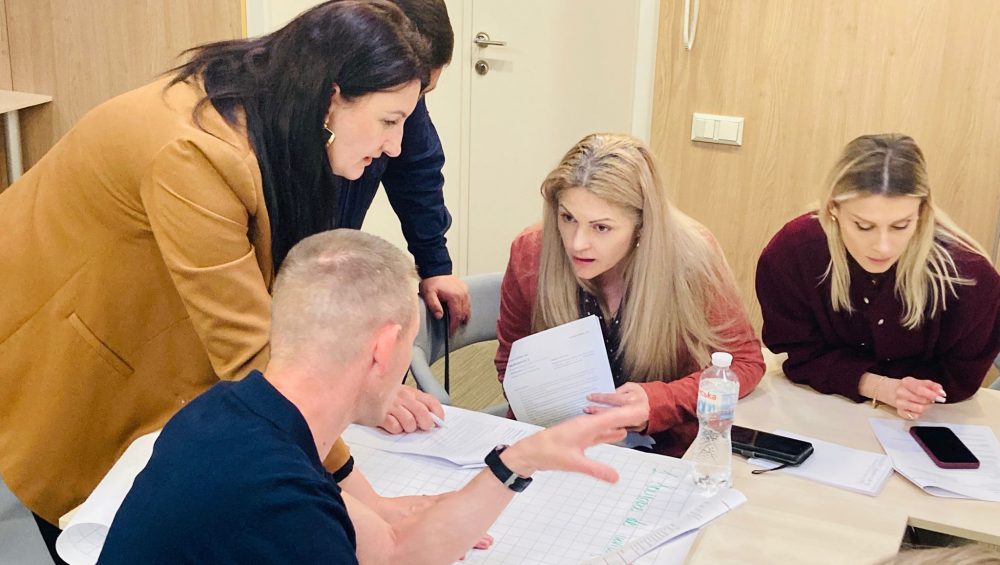
On 29–30 April 2026, the General Inspectorate for Emergency Situations organised the workshop “Strengthening Project Management Coordination in the Context of EU Opportunities” in Chișinău. The event brought together representatives from central administration and territorial sub-units to discuss how institutional coordination mechanisms can be strengthened and the capacity to utilise European and international funding opportunities improved.
The discussions addressed several operational challenges currently affecting the development and implementation of projects within the GIES. In particular, participants reflected on the need for better communication between operational, logistical, procurement-related and IT structures, as well as on the importance of a more coherent mechanism for identifying, prioritising and addressing institutional needs. Particular attention was paid to ensuring that future project proposals are aligned with both national strategic priorities – including the Public Safety Programme – and European funding frameworks.
During the workshop, participants analysed funding opportunities under the EU Civil Protection Mechanism (EUCPM), various DG ECHO programmes and other international funding instruments. Furthermore, the sessions focused on strategic planning, institutional coordination and the development of project concepts to support future investments in specialised equipment, response capacities and institutional infrastructure.
The workshop contributed to a clearer understanding of institutional responsibilities in project development and laid the foundation for a more structured internal project pipeline capable of responding strategically to donor expectations and future calls for proposals. At the same time, the event supported the identification of priority needs at central and territorial levels and promoted a more coordinated approach to the preparation and implementation of projects.
Strengthening monitoring and risk prevention in INTERREG projects – GIBP workshop
On 20–21 May 2026, a second workshop entitled “From Monitoring to Institutional Response: Preventing Irregularities, Identifying Risks and Protecting INTERREG Projects within the General Inspectorate of Border Police” took place, attended by 20 representatives of the General Inspectorate of Border Police. The event focused on strengthening institutional capacities in the areas of monitoring, risk management, audit preparation and the prevention of irregularities within INTERREG-funded projects.
The first day of the workshop was devoted to understanding project monitoring as a practical tool for prevention and internal control. Participants analysed how project implementation can be properly monitored, including activities, deliverables, procurement procedures, payments, deadlines and supporting documentation. Furthermore, the differences between delays, non-compliance and irregularities in the implementation of EU-funded projects were clarified.
Particular attention was paid to identifying risks and early warning signs throughout the project lifecycle. Participants explored the practical application of risk-based monitoring approaches, including probability-impact matrices, as well as the identification of so-called ‘red flags’ during the planning, procurement, implementation and reporting phases. Topics such as conflicts of interest, suspicious links and the verification of beneficial owners were also addressed.
On the second day, the focus was on institutional response mechanisms once potential irregularities are identified. Participants discussed the practical distinctions between irregularities, suspected fraud and fraud, as well as the respective institutional responsibilities and reporting obligations. Furthermore, the workshop addressed common audit findings, vulnerable procurement practices and the risks of financial corrections resulting from inadequate documentation or procedural shortcomings. Using practical examples and case-based discussions, participants reflected on preventive measures and relevant lessons for current and future GIBP projects.
Building more resilient and strategic institutions
Both workshops highlighted the growing importance of strategic coordination, proactive monitoring and institutional preparedness for the successful implementation of externally funded projects. By strengthening internal communication, improving risk awareness and promoting more structured project development processes, GIES and GIBP continue to consolidate their capacity to implement EU-funded projects more effectively, transparently and sustainably.